نقاشان فیگوراتیو معاصر (72) Contemporary Figurative Painters - 72


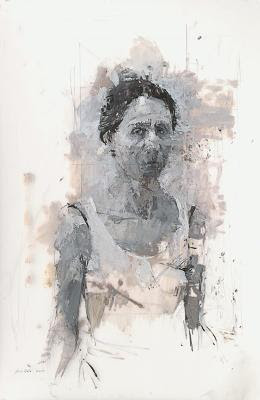
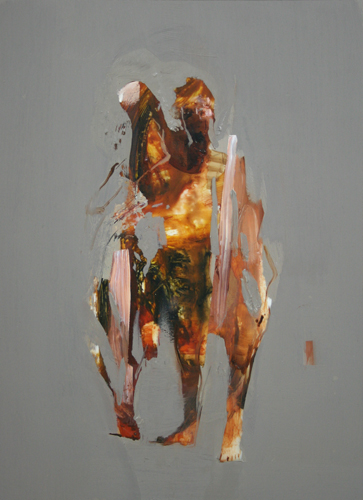
Jason John

Born: 1980, Detroit, Michigan


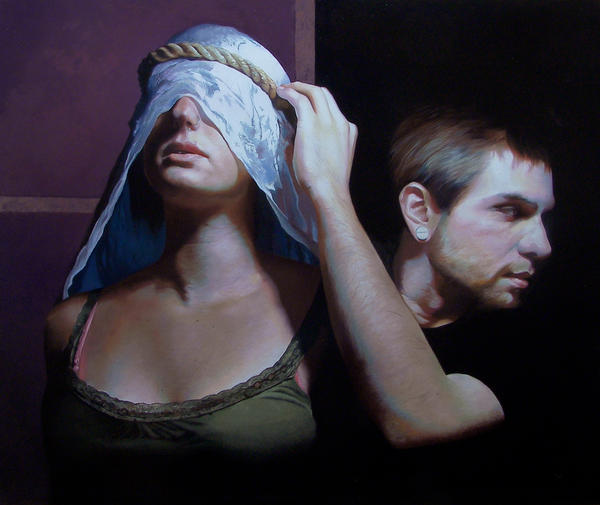
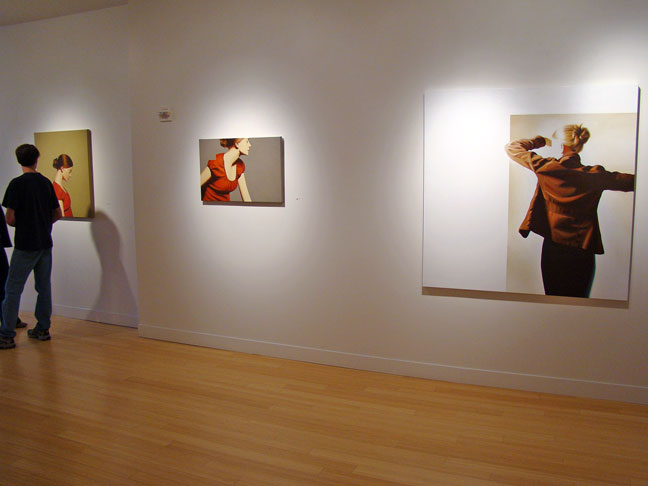
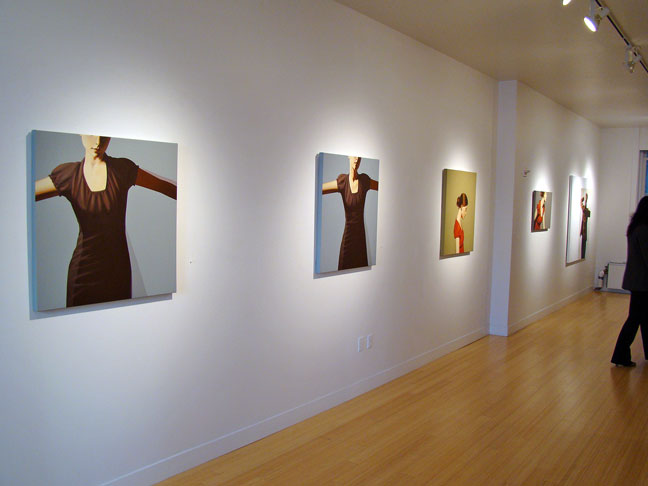
Jason John is a painter working in the style of psychological realism. His goal is to present the viewer with a decisive moment of a larger more sinister narrative. Jason’s work deals with issues of control and submission within our American society.

My interest as an artist is related to how people look back into his or her past to retrieve memories of certain situations. Depending on the situation the individual has experienced can drastically alter the shape of a person’s memory and furthermore, a person’s identity. As a painter and draftsman, I represent particular memory situations from my own life. Some or all of the figures are partially concealed by a vale or mask. By concealing the identity of an individual takes away the personal narrative and identity attached to the represented individual or individuals. My artwork is meant to represent each individual or group of individuals in a memory fragment that has been shifted and altered by time and situation. ... 


نقاشان فیگوراتیو معاصر (71) Contemporary Figurative Painters - 71


Nigel Cox

I was born in Newry Co. Down Irland and grew up on the edge of Dundalk, a

small market twon in county Louth, just below the border.I went the

 Dundalk Grammer School.

As a child I vividly remember drawing cartoons and superheroes from my comics.  

I had a scrapbook of my favourite ones which I kept for years  . . . sadly it 

disappeared in a move.


I chose to go to college in England. Partly because it seemed somehow more exciting 

and adventurous than studying at home. After graduating from Riversdale College in 

Liverpool I joined the Transglobe Expedition, led by Sir Ranulph Fiennes. This three-year 

expedition successfully achieved the first circumnavigation of the globe on land, sea and 

ice via North and South poles along the Greenwich Meridian and changed my life forever.


During the expedition I was at sea, on an ice cap or in some remote location 

for weeks or months on end. Spending large amounts of time alone, surrounded by 

the staggering beauty of vast and often barren spaces had a profound affect and the 

essence of this experience strongly influenced my painting. During the expedition 

I sketched and worked in watercolour, illustrating places of interest in my diary.

For a number of years after the expedition I lived in Germany, painting 

watercolours and oils, exhibiting and undertaking private commissions. 
I also travelled extensively throughout Europe, spending time in Holland, Spain and 

Portugal before finally settling in London in 1990. There my work took on a new 

dimension, incorporating digital illustration.


In 2003 I returned to my most loved medium, oil on canvas and have been 

exhibiting my paintings in the UK and Internationally since.

I live near Camberwell in London, UK where I have a studio at home. 

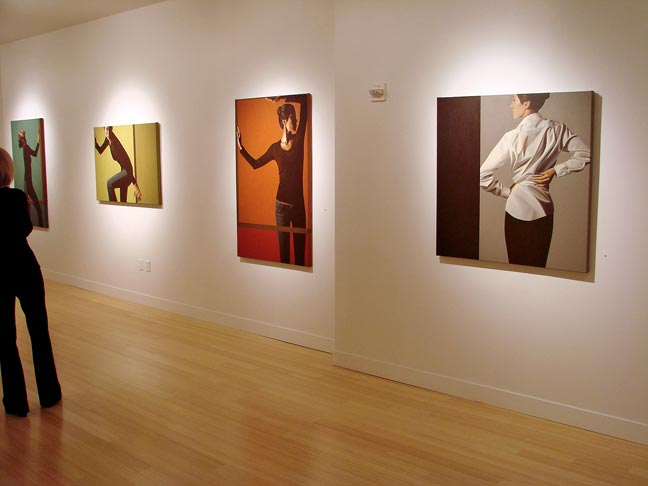
My Art
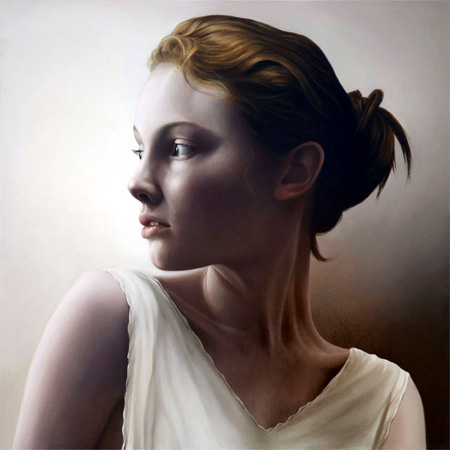
Painting primarily on linen, I build up thin layers of oil paint, 
developing depth and detail. The resulting paintings are smooth to the 
touch and seem to glow with an inner light. 


My love of large open spaces and lack of clutter is obvious in my work but 

I am also fascinated by detail. These opposing elements are merged in my 

paintings in a style which I call Photorealistic Minimalism*.

My paintings provide the viewer with a glimpse beyond the clutter of everyday 

life, conjuring up notions of escape and peace, offering sanctuary from the 

frenetic world outside. 

The figures are alone but not lonely; searching but not anxious, anticipating 

yet calm. They have an inner peace and strength and are at one with their 

surroundings. The paintings reflect solitude, tranquillity and confidence, 

giving every day scenes an unexpected and surreal feeling while keeping 

them solidly within the real world.


نقاشان فیگوراتیو معاصر (70) Contemporary Figurative Painters - 70


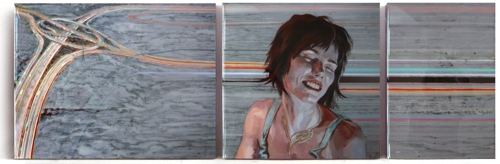
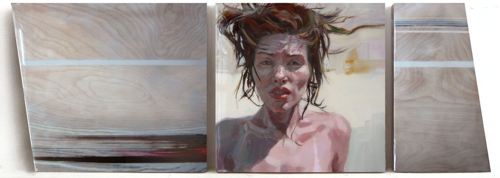
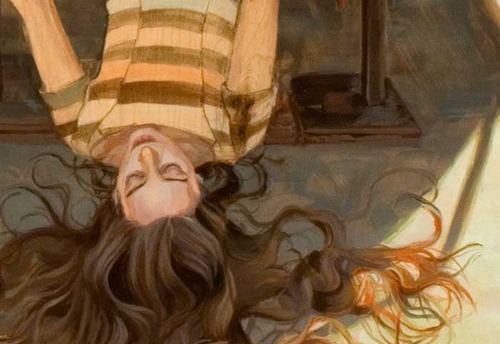
Jazz-minh Claire Moore

In the odd, passing moments of life, I hone in on expressions that reveal breaks in the usual protective veneer we collectively adopt.

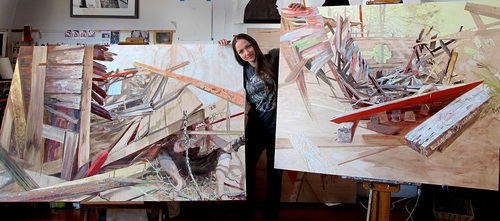
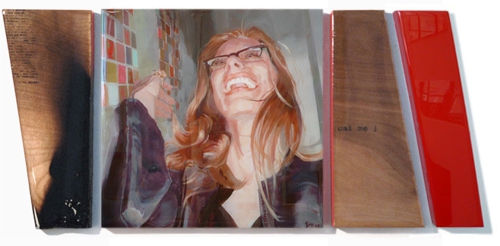
Some sections are left unfinished, others highly rendered.  The level of finish is symptomatic of an evolving collaboration with the organic drawing 'style' present in the wood itself. I leave woodgrain as landscape to influence composition.

I often paint girlfriends of mine, artists or writers who have an inherent ferocity that they must let out - girls who shouldn't leave the house like that... what would people think?  Choosing in-between, raw expressions is my way to applaud something fiercely real and un-simulated.  Through my subjects, I grapple with stark, uncontrollable emotions, lost love, irrevocable choices, and the personal loss of innocence.  Inherent in these themes is my own intractable march, from the near-feral state of a young girl growing up in stark nature, to a civilized, compromised condition.

A poured coat of resin embalming bare woodgrain suggests what I consider to be a defining trait of our culture--the paradox of slick plastic surface beauty with the prevalence of dead surfaces.  Nothing will ever grow from this particular piece of wood again, as the polymer coating will not biodegrade. 

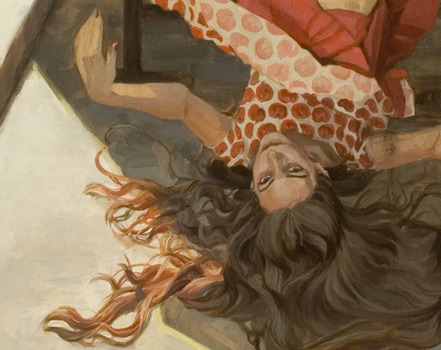
My paintings are not grand.  Every portrait is a small exaltation of a moment in which light, wind, water or emotion brought a human psyche to pause it's viscerally competitive march. Slipping sideways, I fall into a mess of tangled hair, or escape into the wind.

Jazz-minh Claire Moore was born on a hippie commune in the old redwood forests of Oregon, and raised in a small house on a dirt road near San Diego, surrounded by fruit trees. She currently lives in Manhattan's Greenwich Village.


نقاشان فیگوراتیو معاصر (69) Contemporary Figurative Painters - 69


Mayra Barraza

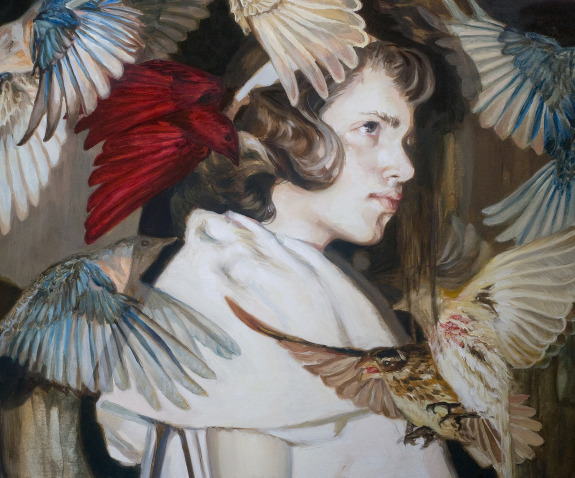
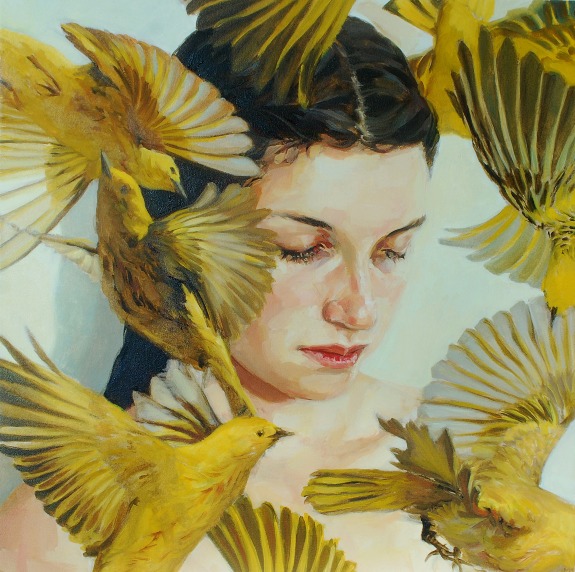
Mayra Barraza (El Salvador, 1966) like a river that opens into streams she is currently working two parallel series of works: one which refers to philosophical aspects via male portraits of diffuse forms, the other which develops conceptual ideas with multiple references via realist paintings of animals. During 20 years dedicated to the arts, Barraza has presented her work in international exhibitions at the Museum of Latin American Art in California, the II Lima Biennale in Perú, the Maison de l’Amérique Latine in Lyon, France, the Centro Atlántico de Arte Moderno in Canary Islands, Spain, the Museo del Barrio in New York, among others. The distinctions of Barraza’s career and her contribution to Latin American intelectual and artistic discourse have confirmed her in the art community as a well recognized artist of contemporary Latin American art. Her work forms part of important private and public collections in the region since her initial art studies at The Corcoran School of Art. She is represented by the galleries saltfineart in California, Liliana Bloch Gallery in Texas and Galeria 1-2-3 in El Salvador. Currently she divides her time in El Salvador between the walls and tasks of the Presidential Secretariat of Culture and her studio-residence surrounded by vegetation and birds.


نقاشان فیگوراتیو معاصر (68) Contemporary Figurative Painters - 68


Erin Cone

Erin Cone's portraits are commanding, enigmatic mirrors of the human condition. A fusion of traditional portraiture and magical realism, Cone's paintings evoke the perspective and emotional complexity of the sitter's interior world. Detached, yet imbued with raw emotion, Cone places her subject in abstract settings devoid of reference to the material world. Cone's bold, minimal compositions encapsulate potent moments and solidify them in an infinite manner. 

Exceptional and compelling, Cone has developed a powerfully idiosyncratic visual language containing strong directional lighting and reductive planes of subdued color. The artist states “I explore the shifting interpretations possible when narrative is omitted and only emotion and ambiguity remain.” Erin Cone's highly stylized portraits contain a modular perfection, revealing a synthesis of figural minimalism infused with essential truth. In the artist's own words, “I want to show all of the emotion of the moment, but none of the context. I seek to capture subtle, ambiguous feeling which each person can approach in his or her own way.” 

Born in Lubbock, Texas in 1976, Cone received her Bachelor of Fine Arts degree from the University of Texas in 1998. Cone's artwork has been exhibited extensively throught the Southwest and East coast. The artist has been featured on the cover of Southwest Art Magazine and American Art Collector.


نقاشان فیگوراتیو معاصر (67) Contemporary Figurative Painters - 67

Ali Cavanaugh


Ali Cavanaugh was born in St. Louis in 1973 and has worked as a professional artist for 17 years. Her compositions are strong and intuitive, thanks not only to being a wife and mother but also to the variations in her experience—such as hearing loss—that made her adapt to and recreate the world around her.

Cavanaugh was awarded the prestigious Presidential Scholarship from the David Wolcott Kendall Foundation, a four-year, full-tuition merit scholarship. This allowed her to study painting at Kendall College of Art and Design and in 1994 She was accepted into the New York Studio Residency Program in New York City. Cavanaugh earned a BFA with an emphasis in painting in 1995. In 1996, she co-founded the New School Academy of Fine Art in Grand Rapids, Michigan.

She has had 40+ solo and group exhibitions in galleries throughout the U.S. Cavanaugh’s art has been featured in publications such as New American Paintings no.88, American Art Collector, American Artist Watercolor, Watercolor Artist magazine, Southwest Art magazine, International Artist magazine, Art Calendar magazine, and The Daniel Smith Art Supply Catalogue.


In 2005 I began painting watercolor on paper, but because the paper became a huge limitation, I began searching for an alternative. I wanted to find a surface that would not need to be framed. In 2004, while living in Santa Fe, a skillful Mexican craftsman taught me an application of plaster to interior walls over adobe block construction using water and trowels. This technique is common in the southwest. The process of applying the plaster with trowels and water led me to search for a plaster surface that would take watercolor pigment. Frescoes play a big roll in art history but I hadn’t met an artist working in this method. Fresco secco is the term used for painting on a cured plaster surface, and after a bit of research, I found that there are many artists still working in this ancient process. Since my process is inspired by the traditional fresco secco and is not technically “fresco secco” as art historians would define it, I call my process “neo fresco secco”. My first step was to find a plaster or clay that was pH balanced. I found kaolin clay which is known for its ph balance and superior archival properties. When googling a supplier of this product, I discovered Ampersand. They produce art panels with a kaolin clay surface. Their construction and craftsmanship impressed me and I decided that I would have this company produce my art surfaces.

My process of paint application is very similar to egg tempera; I use small controlled strokes of overlapping colors to create depth while letting the white clay surface illuminate through the pigment. These small strokes of color are built upon a wet plaster surface. Once the painting is fully dry I seal the work with an archival UV protector.


نقاشان فیگوراتیو معاصر (66) Contemporary Figurative Painters - 66


Costa Dvorezky    Born 1968

Costa has drawn inspiration for his prolific works of art from broad travels and his abundant life experiences as both a visitor and resident of numerous countries. Born in Russia in 1968, Costa developed his unique brand of art through extensive schooling at the Art College and the Academy of Arts in   Moscow. His passion and talent for art was recognized by Russia’s Union of Young Artists when he received the Development of The Year Award in 1997.

Through his paintings Costa goes beyond the obvious to uncover the symbolism within the human aspect of daily life. His creativity and style come alive through his dark and surreal imagery. As a viewer of Costa’s images, one is transported to a world of fictional proportions that exists in the recesses of the artist’s mind.


Metamorphosed human and animal figures shrouded in darkness, suggest the existence of a distorted world-order. These images evoke one to closely examine and question the reality of what one sees. Through his artwork, Costa challenges the observer to not only understand the scope of the actual image, but to also comprehend the feelings that the image provokes. His paintings are as bold as the statements that they make, and it is up to each individual to decipher what the meaning behind the image really is.

Costa’s art has achieved international recognition. It has been featured in many private and public exhibits on European and North American stage, and has been sold to many private collection in Europe, the United States and Canada.

STATEMENT

Through his paintings Costa goes beyond the obvious to uncover the symbolism of the human aspect of daily life. His images are a study of the human reality presented in a simplistic and surreal existence. The human form is the focus. Intricate details and lines of the human body are juxtaposed against a stark background revealing the artist's conviction of the important role of man and woman's existence. Through his artwork, Costa invites the observer to not only understand the scope of the actual image, but to also experience the reality of the other and comprehend the feelings that this experience provokes.


نقاشان فیگوراتیو معاصر (65) Contemporary Figurative Painters - 65


Meghan Howland
b. 1985  Haverhill, MA
Currently lives and works in Portland, ME


BFA      2008      Painting     New Hampshire Institute of Art, Manchester, NH     Study Abraod 2007 Firenze Arti Visive, Florence, Italy


Meghan was born in Haverhill, Massechusettes in 1985. Her paintings are often dreamlike, and yet carry a weight of something that is slightly more dissonant. The question of whether something is safe or dangerous, loving or hateful is often unexplained in her work. While conveying a situation or mood that is slightly ambiguous, this makes it up to the viewer to resolve what is happening, creating an unending range of emotions and possibilities.


نقاشان فیگوراتیو معاصر (64) Contemporary Figurative Painters - 64


Andrew Salgado

Andrew Salgado (b. 1982, Regina, Canada) has exhibited in the United Kingdom, Germany, Scandinavia, Australia, Venezuela, Thailand, Korea, South Africa, Canada, and the United States.  His bold, assertive, and generally large-scale figurative paintings have placed him as one-to-watch in both the UK’s and North America’s painting scenes. Solo exhibitions include In Order To Rebuild; Dosi Gallery, Busan, Korea (2012); The Misanthrope, Beers.Lambert Contemporary, London, (2012). Forthcoming solo exhibitions include London, a collection of works commissioned by the UK-retailer Harvey Nichols, London, UK (April-June, 2013); The Smallest Heart’s Desire, La Petite Mort Gallery, Ottawa, Canada (May 2013); and The Acquaintance, his first institution-exhibition at The Art Gallery of Regina, in his home-town of Regina, Canada (October 2013). Solo exhibitions in 2014 include Christopher Møller Art, Cape Town (January); One Art Space, New York City, NY (May); and Beers.Lambert Contemporary, London UK, (October).

Salgado’s paintings have hung alongside works by Tracy Emin and Gary Hume in London’s Courtauld Institute of the Arts, was the highest-grossing work ever donatedto Canada’s esteemed Art For Life (18th Annual) Charity Auction (2011
He has lived and worked in London, UK since 2008.


نقاشان فیگوراتیو معاصر (63) Contemporary Figurative Painters - 63


Chawky Frenn


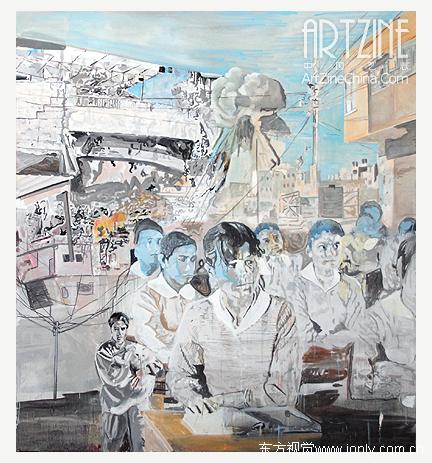
Born in Zahlé, Lebanon, Chawky Frenn lived his formative years in a country of beauty, mysticism and conflict. He witnessed six years of civil war whose devastating images and consequences would powerfully influence his life and work. He moved to the United States in 1981.

In 1985 Frenn received a BFA from Mass College of Art, Boston, MA, and in 1988 he completed his MFA from Tyler School of Art of Temple University, Philadelphia, PA. He spent his second year of graduate studies at Temple Abroad in Rome, Italy. He taught at Bridgewater State College, Bridgewater, MA; Montserrat College of Art, Beverly, MA and Edinboro University of PA, Edinboro, PA. He is currently an Assistant Professor at George Mason University in Fairfax, VA.

Frenn exhibits extensively, nationally and internationally. He had shows in the US, France, Germany, Lebanon and Paraguay. In 2000-2002, Frenn's first traveling show ECCE HOMO was hosted by Vanderbilt University in Nashville, TN; George Mason University in Fairfax, VA; the Hoyt Institute of Fine Arts in New Castle, PA; the Housatonic Museum of Art in Bridgeport, CT; the Erie Art Museum in Erie, PA and St. Paul's School in Concord, NH. He participated in many museum shows; Arnot Art Museum's "Re-presenting Representation" in Elmira, NY is the most recent.

Frenn received numerous awards: Blanche E. Colman Award, Mellon Trust, Boston, MA, in 98; The Stacey Scholarship Award, The National Academy of Western Art, Oklahoma City, OK and The Sheldon Bergh Award USA, Basil H. Alkazzi Award, London, England, both in 93; Gibran Khalil Gibran Foundation Grant, Gibran Khalil Gibran Foundation, Boston, MA in 82, 83 and 84. He was a Finalist in the Teaching Excellence Award in his first year at George Mason in 00-01.

Beside positive reviews and critical acclaim by varied newspapers and magazines including the New York Times, NY ARTS, Art New England and the Boston Globe, a 72-page catalogue documenting Frenn's work has been published to accompany the traveling show ECCE HOMO.

Frenn lives and works in Arlington, VA.


نقاشان فیگوراتیو معاصر (62) Contemporary Figurative Painters - 62


Harry Ally


BORN

1949 in Somerville, NJ

Lives and works in Ohio and Georgia


EDUCATION

1976 MFA, (Drawing, Painting, and Ceramics), North Texas State University, Denton, TX

1972 BFA, (Painting and Ceramics), Texas Christian University, Fort Worth, TX

Harry Ally is from Bridgewater, New Jersey.  He has an MFA degree in painting from the University of North Texas and a BFA from Texas Christian University. He has been a Professor of Art for over thirty years and is now retiring from Valdosta State University as an emeritus professor.  His work has appeared in many national and solo exhibitions across the country. He has won numerous awards for his work and many of his pieces are included in private and corporate collections. He has been represented by a number of galleries over the years including the Bill Lowe Gallery in Atlanta, the Soren Christensen in New Orleans, the Stricoff  in NYC, the Craighead Green Gallery in Dallas, among others.


Artist’s Statement 2012


My work follows in the long tradition of painting. For me painting is the primal impulse to mark.  It’s a visual record of the mind, the body, and the human spirit.  It’s about a need to both create and to destroy.  Maybe it’s out of sheer frustration that I paint, maybe it’s out of a need to violate or to contradict, or possibly, it’s simply about the pure enjoyment of mark-making, either way, there is a strong feeling present and I feel compelled to react to this feeling.

The content in my work is often ambiguous and rooted in a surrealistic trust of intuition. The work is related to the gestalt, an incompleteness that suggests rather than illustrates. In some works an obvious image appears, other pieces are less obvious and are often layered with fragmented ideas, incomplete thoughts, and multiple meanings. Each painting usually begins without a preconceived image. They begin with a series of random mark-making.  Marks, images, textures, and colors often appear, then are revised, altered, corrected, rejected, and at times even accepted. The works are based on an improvisational search for correctness with an emphasis on documenting the history of the painting. They are a response to the physicality of painting, a love of materials, an appreciation of process, and to the seduction of surface.  The paintings allude to the beauty of decay, to violation, and to vulnerability.  They are excavations, a palimpsest of surfaces layered with a variety of materials...dry pigments, acrylics, tar, fabrics, oils, bonding agents, along with different clays dug from the Georgia soil.  From these materials figurative images are often unearthed.  At other times paintings are often left devoid of specific visual references completely and rely solely on pure abstraction.  They are surfaces that attempt to reveal a sense of time and a certain kind of depth, a depth that is both physical through build up and layering as well as emotional depth through destructive scarring.  In the end the works are about a search, a search for truth and a search for correctness through the act of painting.


نقاشان فیگوراتیو معاصر (61) Contemporary Figurative Painters - 61


Michael Peck

1977 Born in Melbourne, Victoria


Michael Peck’s artistic practice is concerned with the sensation of disorientation and dislocation that is often felt within the post modern world. Exploring issues regarding the loss of cultural identity, his work particularly focuses on the effects within minority groups and individuals existing on the fringe who are challenged to assimilate within the larger community.

The scenes in Michael’s paintings are quiet, the participants are paused as they stand withdrawn, juxtaposed against a dynamic population; they are overwhelmed by mass-culture; one which has been composed from the interaction, assimilation and constant change of subcultures. His work looks at the place of the individual within a pluralistic society where a constant shift of values and beliefs leaves a great uncertainty of belonging.


نقاشان فیگوراتیو معاصر (60) Contemporary Figurative Painters - 60


Philip Gurrey

Contemporary British Artist

2011-2012   M.Litt Fine Art Painting, Glasgow School of Art, UK

2002-2007   BA (Hons) Fine Art Painting, Glasgow School of Art, UK


نقاشان فیگوراتیو معاصر (59) Contemporary Figurative Painters - 59


Alles über Rolf Mallat

1957 in Bonn geboren
 
1976 Abitur und anschließend Zivildienst

1978-83 Kunststudium an der FH in Köln bei Prof. Alfred Strack,  mit Schwerpunkte  Akt- und Porträtzeichnung bei Rolf M. Koller und Radierung bei Maurilio Minuzzi

1981 Beginn der Ausstellungstätigkeit im Köln-Bonner Raum, später bundesweit und im Ausland (u.a. Genk, Brno, St. Petersburg und Minsk). Ab 2000 regelmäßige Teilnahme an national bzw. international ausgeschriebenen Kunstausstellungen
 
- u.a.: Große Kunstausstellung NRW und München, „Lucas-Cranach-Preis“ Wittenberg (Endauswahl),   Internationale Kunstausstellung  Hollfeld,   Kunstpreis für Malerei (1. Platz) Dierdorf,   Stadtmuseum Siegburg,   Endauswahl „Wilhelm- Morgener-Preis“ Soest, Nord Art Büdelsdorf/Rendsburg,   „Lucas-Cranach-Preis“ Kronach (Endauswahl). 

Mitglied im Berufsverband Bildender Künstler (BBK)  Bonn, Gründungsmitglied der Künstlergruppe „6+2“, Mitgründer der Kreativwerkstatt Troisdorf (Kunstschule), Mitglied der Bonner Künstlergruppe Art 7 und des Rhein-Sieg-Kunstvereins.

Lebt und arbeitet in Troisdorf.

Der Schwerpunkt meiner künstlerischen Arbeit liegt in der gegenständlichen Malerei. Der Mensch ist das zentrale Thema. Stilbrüche, abstrakte Bildelemente, historische- und kunsthistorische Zitate sieht man nebeneinander und  ineinander angeordnet und ergeben „Bildstörungen“, die zur Reflexion über  unser menschlichen Daseins anregen.


نقاشان فیگوراتیو معاصر (58) Contemporary Figurative Painters - 58


Agaphya Belaja

2001— graduated from I.E. Repin Institute for Painting, Sculpture and Architecture. Monumental studio.

Since 2002 — Probationer at I.E. Repin Institute for Painting, Sculpture and Architecture.

1999 — participated in the mural painting of Christ Savoir Church, Moscow, Russia and Znamensky Cathedral of the Virgin Mary in Kursk, Russia

2001 — was awarded a presidential fellowship and an honorary recognition from the Russian Union of Artists.

2005 — became a winner in the Second All-Russia Competition of Young Artists held by the world-famous Tretyakov Gallery in Moscow.

2007 — member of group exposition of the "Academy of Arts" Foundation, Delft, The Netherlands


نقاشان فیگوراتیو معاصر (57) Contemporary Figurative Painters - 57


Vania Comoretti was born in Udine (Italy) in 1975.
She works and lives in Udine and Venice.

After achieving a five-year schooling certificate in Applied Arts, she attended several courses in advertising graphics and in 2004 graduated in Restoration, Painting section, at the Venice School of Fine Arts (Italy).


نقاشان فیگوراتیو معاصر (56) Contemporary Figurative Painters - 56

DANA SCHUTZ

Born in 1976, Livonia, MI 
Lives and works in Brooklyn, NY
 

Dana Schutz's work has been described as ‘teetering on the edge of tradition and innovation'. 'My paintings are loosely based on metanarratives. The pictures float in and out of pictorial genres. Still lifes become personified, portraits become events and landscapes become constructions. I embrace the area between which the subject is composed and decomposing, formed and formless, inanimate and alive. Recently I have been making paintings of sculptural goddesses, transitory still lifes, people who make things, people who are made and people who have the ability to eat themselves. Although the paintings themselves are not specifically narrative, I often invent imaginative systems and situations to generate information. These situations usually delineate a site where making is a necessity, audiences potentially don't exist, objects transcend their function and reality is malleable


نقاشان فیگوراتیو معاصر (55) Contemporary Figurative Painters - 55


JEFFAR KHALD

Born in 1964, Lebanon 
Lives and works in Dubai, UAE

Khaldi doesn’t consider himself to be a political artist; the themes in his work evolve from his own experiences and ideas and thus provide the most powerful material for making art. In his canvases, harsh realities become mixed with imagined scenes, confusing fact and fiction with a sense of nostalgia or dreams. His tableaux are equally beautiful and uncertain. In Frozen, a man is rendered midfall, his position beatific and Christ-like. In the distance encampments of tents line the landscape, reminiscent of Palestine’s occupation.

Khaldi’s paintings convey theatricality in their portrayed subject matter and in their physical construction. Alongside modern influences such as the German Expressionists, Khaldi cites Persian miniatures as an interest in developing his work. His large-scale canvases evoke similarity to this ancient tradition in their geometrically balanced compositions, overwhelming detail, and flattened sense of space. In The Infinite And Beyond the image becomes almost secondary to the spectacle of its making. The landscape is rendered with luscious mimetic sensibility: water created from thin liquidy washes, sky rendered with breezy-smoggy strokes, earth with dirty fields, and trees as shady patterns cut through with spindly twig-like gestures. The wall and building in the distance seem conspicuously solid in relation to their organic surroundings. The figure in the foreground is an almost ghostly apparition, his facial features duplicated, and arms heavily outlined in white suggest movement.


نقاشان فیگوراتیو معاصر (54) Contemporary Figurative Painters - 54

Mao Yanyang

Mao Yanyang was born in Hunan, China in 1980.

In 2002, he obtained his Bachelor's Degree of Fine Art from the Oil Painting Department of one of the most elite art academies in China, the Sichuan Academy of Fine Arts. He was one of the very few top students selected to participate in the Sichuan Academy's Master's Degree Programme, which he completed in 2005. 

In 2005, Mao participated in his first important museum show at the He Xiangning Museum in Shenzhen, China. And in 2006, he was selected to participate in his first international exhibition in Pusan, South Korea. 

In 2007, Mao Yanyang was selected as one of the top 25 emerging Chinese artists (out of over 1,000 applicants) at the Chinese Art Prize 2007. He was then selected as the Chinese Art Prize (CAP) 2008 Gold Prize winner by the Director of Art Cologne, Gerard Goodrow, the Curator of the Asian Art Museum, Jeff Kelley, and a prestigious panel of jurors.

The Chinese Art Prize recognised Mao Yanyang as one of the top Chinese contemporary artist talents. In 2007, Mao's work was exhibited at the Zhu Qizhan and Duolun Museums in Shanghai andat the BS1 Contemporary Art Museum in Beijing. He has since exhibited in Europe, at Art Cologne, as well as in New York.

In 2008, Mao Yanyang was selected to participate in the Asian Triennial in Manchester, UK. He was also awarded a scholarship to study at the Chinese Arts Centre in Manchester, United Kingdom.


نقاشان فیگوراتیو معاصر (53) Contemporary Figurative Painters - 53


Pilar Mehlis

Artist Statement


My work uses visual metaphor, allegory and magical realism to explore psychological truths about the human condition. My work also blurs traditional distinctions such as serious vs. trivial or tragic vs. comic. My compositions are not bound by conventions of time, space or form. This indeterminacy is meant to draw the viewer into a dialogue with the work, deepening their experience and enjoyment of it.

I paint from models and my imagination. Sometimes the characters in my work go through a few transformations before their final forms emerge. I like to think this process is not unlike the building of my characters' psychological dimension.  Aided by classical compositions and colour palettes, I "collage" different scenes that come to mind in a constant process of addition and elimination as I build the composition of each work. I reference the great masters for painting methodologies, from Leonardo da Vinci, Michelangelo, Botticcelli, all the way to Odd Nerdrum and Lucian Freud. I use the tonal approach and build layers in oil to achieve a luminous effect to the skin tones and other elements in my paintings.


نقاشان فیگوراتیو معاصر (52) Contemporary Figurative Painters - 52

Paul Bennett

My creative process for figurative paintings begins initially from found images (magazines, Internet), which are used as a base from which I begin to sketch out the composition. It’s important to my work that the initial reference images are from a mass produced source for a couple of reasons. The first is that the paintings I want to create are completely removed from the polished magazine shoots and plastic people portrayed from which I am referencing. The bombardment from advertising and the media of immaculate people has for many years become the normal way that we absorb our visual life. The act of taking the person out of the context of material advertising is a way in which what is left can be open to scrutiny and reinterpreted. The flat and empty backgrounds I use help enhance this. The second reason why I favour the use of the found image is that there is less of a connection with the subject and in some ways it is similar to painting a still life. The subject is removed as a person (to some extent). This then gives me more freedom to reinvent and create the painting in a more expressionist way and break free from a photorealist portrayal of the subject. The very act of painting something which has already been produced many thousands of times already becomes a completely different entity when it is then used to create a one off and unique original piece of work. The intention is that the end result be a million times removed from the person who at some point posed in front of the camera.

The right found image is also hard to come by and can take a long time to find. Finding an image where the subject is not looking directly out of the canvas, in most cases, seems to work best. It helps as it puts an extra barrier between the subject and the viewer; the slight gesture of looking away hints at some kind of emotion and re-establishes a connection on a more subtle level.

I like the paintings to have an unfinished feel about them and to communicate being incomplete when compared to what we are normally presented in our everyday relationship with mass produced visuals. Using the combination of oil paint, graphite and letting the paint freely drip and also the use of distinctive mark making all helps in achieving this. However, it is still one of my aims to maintain the slightest hint that there was once glamour.


نقاشان فیگوراتیو معاصر (51) Contemporary Figurative Painters - 51


Zachary Walsh

. Masters of Art, Royal College of Art, London. .

 First class honours degree, John Moores Liverpool University. 

'Whilst Walsh is a well schooled artist, having studied at the hallowed grounds of the Royal College of Art, he is just as prone to take his influences from broader sources than academia. The vernacular of street art, fly posting, and urban sprawl, besides a consciousness of graphic design sensibilities all jangle for attention with an almost classical painterly feel. Technically, and it is so rare that I get to write this, Walsh is superb, he gambles, stretches himself, to a point whereby most painters would fail, fall, but Walsh pulls off his gambols, his masquerades, his cheeky unapologetic symbolism. He has a knack of painting simply, concisely, with economy and brevity of phrase and yet he can still introduce noise, aberration, dissonance into his subjects. He controls his paint as much by letting go as by reigning in, there are drips, stains, brushstrokes, smears and yet the whole, amalgamates, forms an engaging image. There is a masterful feel for portraiture, expressions, gestures, poise and pose of the human physiology. The backdrops often sparse, serve to focus the foreground, and the fields of bold colour behind, often in crosses or geometric shapes, incorporate abstraction convincingly. His ability to convey the movement of cloth, the kinetic force of wind on material, or sculpted round the body is second to none, and again brings back a sense of classical training and of course the embedded innate talent of the artist.'


نقاشان فیگوراتیو معاصر (50) contemporary Figurative Painters 50


Ann Gale 

Born in 1966, Gale, whose mother is also an artist, grew up in Rhode Island and began painting around age 7. “I was obsessed with painting people,” she recalls. “I used to love football season, because my father would sit very, very still.” In her undergraduate studies at Rhode Island College and graduate work at Yale, even as she studied printmaking and sculpture, she found herself returning to painting, still fascinated by “that thing about a person’s face that sticks with you, to the point that you’re still thinking about it later.” After Yale she exhibited in galleries in New York, San Francisco and Seattle, where she eventually accepted a teaching position at the University of Washington School of Art. Currently she is on sabbatical, painting full-time thanks to a Guggenheim Fellowship she was awarded last year. The APEX show is her first solo outing in a museum.

Ann Gale’s work takes a decidedly formalist approach to figurative painting, without losing any of the pathos of her brooding subjects. She paints from life, and instead of blending colors on the surface, Gale layers hundreds of carefully pre-mixed strokes of paint one on top of the other. From afar, the eye mixes the colors to create stunningly realistic portraits. Up close, one can contemplate the abstract shapes. Her technique, to me, seems to deconstruct what a figure is–to reinterpret the human body through the luscious medium of paint itself. The muted palette she uses has a calming effect, but the work is far from boring due to her intense scrutiny of the human form and her ability to capture the complexity of the singular gaze, body language, and, for lack of a more scientific term, aura of each sitter.


نقاشان فیگوراتیو معاصر (49) Contemporary Figurative Painters 49  

Kristine Moran

I’ll often start with a loosely constructed narrative at the beginning of a painting series. This sets the direction and tone of the work. But once a painting gets under way, the work really takes on its own form, and the narrative recedes back. For the past few years I’ve been working with this idea of dissolving notions of self through painting. Many paintings begin with the idea of a figure or space undergoing a sort of metamorphosis. As the figure goes from being recognizable—or representational, into something irrational—or abstract, notions of self are deconstructed, and ideas about one’s identity become much more open-ended. I’m especially interested in how abstraction can be used to transform concrete ideas of place and self into open-ended forms that lend insight to the primal side of human nature. A painting like Steam Bath (2008), for example, clearly has a figurative element to it. At that time, I was thinking a lot about a person’s ability to suddenly transform into something purely animalistic, sexual, or violent, as a reaction to their environment. That particular painting is really about one moment in time. Whereas other paintings are part of a larger series, where the viewer can be a witness to the protagonist’s transmorphing shape from one painting to the next.

 I’ve recently been thinking about these protagonists as acting out a form of unconscious desire, a negotiation between imposed social constructs and the need to have an unconstricted sense of self. Drawing parallels to Lacan’s theory of the mirror stage—where a child recognizes its own image in the mirror for the first time but feels a disconnect between the reflection that is whole and contained versus the belief that it instantaneously exists everywhere and without concrete form—this latest series of paintings, of which Self-efface (2010) and Reclining Nude (2010) are examples, reflects a fragmentary idea of the self through the symbolism of refracted light. In my own artistic practice, as I begin the process of deconstructing painterly forms of corporeality, I similarly have to negotiate between the cognitive process of thought, where judgment and the weight of history can interfere with the much more desirable intuitive aspect of painting. There are instances, usually occurring very late at night, when the unconscious mind takes over, and is directly manifested through the physicality of the painted gesture. In this sense, abstraction becomes the best vehicle for this process to occur.

 I offer the viewer some information, whether it is through pictorial cues, depiction of space or a given title, in the hopes that he or she can locate themselves within the painting. My work generally tends to be a slow read, but once the viewer becomes invested, he or she has the opportunity to take the representational cues as entry points into the abstract forms that dominate. This ideally allows the viewer to enter into a fantastical space that parallels that of the protagonist. As concrete figures and spaces devolve into abstract shapes of ephemera, the viewer’s experience of the painting becomes increasingly open-ended, as is the interpretive nature of abstraction.


نقاشان فیگوراتیو معاصر (48) Contemporary Figurative Painters - 48


Karim Hamid

Born 1966 – Lives and Works between Rhode Island & London

Karim Hamid’s images are based on the visual dialogue with the classic representation of the female figure and the male gaze throughout art history. Hamid’s work updates the visualization of the idealized female form through the distortion and transformation of the human body.

Karim Hamid’s paintings function as a psychic response to an unconvincing onslaught of media superficiality and the pervasive objectification of the female form in art history. The goal of his paintings seems to be to distort and exaggerate this emphasis on an idealized form.

In his paintings he is focused mostly on the psychic condition of the person observed, something not readily available to the conditioned eye. In his portraits, or anonymous found imagery, he expects the same thing – to find something broader in the meaning and composure.

“While the imagery is often distorted or exaggerated in my work, I also expect my work to express itself within its own polemical and painterly distortion of that distortion. It is about the thing/person being observed, as well as the method of being observed.”


نقاشان فیگوراتیو معاصر (47) Contemporary Figurative Painters - 47


Daniel Ochoa

Born 1980 in Santa Rosa, California.

Statement

The experiences I had growing up in a bicultural family fuel the imagery, and emotional quality of my work. My father is an immigrant from Mexico, and my mother a white American. Overtime, I learned to perceive cultural dichotomies and accommodate conflicting viewpoints. The deconstruction of my identity is at the root of what I paint and how I paint. I explore personal experiences through my work that are informed by photos, emotions and memory. Working in layers, I use masking techniques to jumble formal qualities such as abstraction, realistic representation, pixel emulation, and written narrative. Combining divergent elements suggests a pluralistic reality, and the imagery demonstrates the difference of my bicultural perspective.


نقاشان فیگوراتیو معاصر (46) Contemporary Figurative Painters - 46


« JEAN-PIERRE RUEL
1970 -

The eyes of the figures rarely meet in Ruel’s works, but the unity of the compositions seems to bring them together. This admirable identifying of the pictorial depiction with its subject infuses the work with a rare spirituality. Ruel creates a sense of warmth and of generosity with his brushstroke, at once rich and confident and touched with spontaneity. The artist comes back over his subject time and time again, letting the viewer watch him work through a shape in the traces he leaves behind. Ruel revels in the medium of oil in all its splendour and in all its diversity. The artist’s preference for painting on a large scale is evident, but in his new series he has also created smaller works in gouache on paper, which offers him a chance to work with another medium of interest to him and which suits the artist’s style admirably at that size. »


نقاشان فیگوراتیو معاصر (45) Contemporary Figurative Painters - 45


William Goodman

Mississippi artist William Goodman's portfolio is striking in its diversity. From stark abstract paintings to sexy black-and-white photography to the occasionally grueling commission piece (more on that later), the 29-year-old works hard to earn a living as a full-time artist. And when he's worn out at the end of a long day, he breaks out the scissors and starts snipping.

Working in his live-in studio in the artsy Jackson neighborhood of Fondren, Goodman digs through hundreds of vintage magazines that he's collected over the years — McCall'sLifePlayboy — with nothing later that the 1970s making an appearance. He flips through the musty pages until inspiration strikes.

"I'm very meticulous about cutting everything out," Goodman says. "I'll spend four or five hours cutting out lots of different shit, then I think, this girl would look good coming out of this guy's body, or this animal head would look good ... It's mindless. It just kind of makes sense at the time, but looking back I'm just like, wow, that was really weird."

Goodman brings his weird creations to Charleston with Smut and Paste at SCOOP Studios this week. Co-owner Saramel Evans, a Mississippi native as well, recruited her hometown friend for the show, which will feature a number of smaller, affordable pieces for young collectors and holiday buyers.

"It's a good break for me," Goodman says. "This is me having fun with my art and taking a break from the strenuous commission work that I do. I love doing all different types of stuff, but this is a relief."

While Goodman's creation process is admittedly mindless at times, his collages reflect a fascination with the past that's demonstrated in much of his work. Like his photography and mixed-media pieces, the collages have a sexy, cheeky, and sometimes glamorous air. They're layered, colorful, and complex, with snippets of words reflecting a deeper meaning as well as Goodman's love for typography. As with his other mediums, beautiful women often make appearances in the collages — mostly prim and pretty housewives, with the occasional disrobed alter ego making an appearance.

"This work definitely has a sexual twist to it in a lot of different ways, lots of hints of words like fantasy and seduction," Goodman says.

In one piece, a blonde in a structured white bra reclines, cut off at the waist. A knotted snake-like tube makes up the bottom half of her body, and the words "begins with love" stretch across the bottom. In another, a woman in black panties and high heels kneels, blindfolded by a long scarf. Words like "lust," "offer," and "Motor Inn" are scattered across the canvas.

Though some of the pieces are slightly titillating, Goodman says the show is family-friendly. "It's not a pornography show by any means," he says. "There might be a little nudity in it, but I think for the most part it's just kind of dirty, but fun at the same time."

He adds, "That part in all of us that wants to be living on the edge a little bit, hopefully this will bring that out a little bit."

In one of the more innocuous collages, a man in a sharp suit and sunglasses smokes a cigarette. Images of a classic car and a woman's face are visible to the side, surrounded by various patterns and colors and words like "reveal," "how to," and "vanish."

"There is a meaning for me," Goodman says. "It's just taking something old that maybe people have forgotten about, that's been sitting in an attic or a flea market for years collecting dust, it's taking something old and trying to bring it back to life through color or composition.

"These are referencing sex, broken home life, just kind of that distorted Americana feel," he adds.

While Smut and Paste is mainly focused on Goodman's collage work, he'll bring along some larger mixed-media pieces as well. But there are a few creations — namely commissions — he'll be leaving behind.

"Believe me, I've painted a lot of things over the years I haven't enjoyed painting," he says. "People's sail boats or little poodles — but that's the sacrifice. I'm still getting to do what I love.

"I work my ass off, this is all I do," he adds. "I create every single day, and I love it. I'm about to be 30, and if you would have told me that I could make a living doing my art 10 years ago, I wouldn't have believed it."


نقاشان فیگوراتیو معاصر (44) Contemporary Figurative Painters - 44

Mary Jane Ansell


Mary Jane Ansell graduated from Brighton University in 1994 and now works from her studio in the heart of Brighton’s North Laine.

After only beginning to seriously exhibit her work in 2002, she was selected for both the 2004 BP National Portrait Award and The Daily Mails Not the Turner Prize she was also prize winner in LondonArts Art of Love competition held at the Arndale Gallery, Cork Street London.

2004 also saw her supporting the national charitable initiative Big Arts Week spending a week with children, at Stanford Infant School during June encouraging them to explore portraiture for themselves.

2005 continued to be just as eventful. Mary Jane won the Sussex Open Painting Award at Brighton and Hove Museum and was selected for the Royal Society Of Portrait Painters annual exhibition at the Mall Galleries in London followed by a second selection for LondonArts Art of Love competition held at the Oxo Tower Gallery, London in February.

2006 opened with an invitation to produce a portrait, one of 150 to be auctioned as part of The National Portrait Gallery’s 150th Anniversary Gala celebrations. Along with celebrities such as Mario Testino, Bruce Oldfield, Sam Taylor-Wood, Sophie Dahl and Jerry Hall – artists and sitters joined forces for National Portrait Gallery’s 150th Anniversary Appeal: ‘Collecting for the Future’ raising money for future collections.

Mary Jane is currently working towards her next solo show be held at Fairfax, Chelsea in Sept 2009.

نقاشان فیگوراتیو معاصر (43) Contemporary Figurative Painters - 43


Leon Golub

Date of Birth: 21 January 1922, Chicago, Illinois, USA

Date of Deat: 8 August 2004, New York City, New York, USA

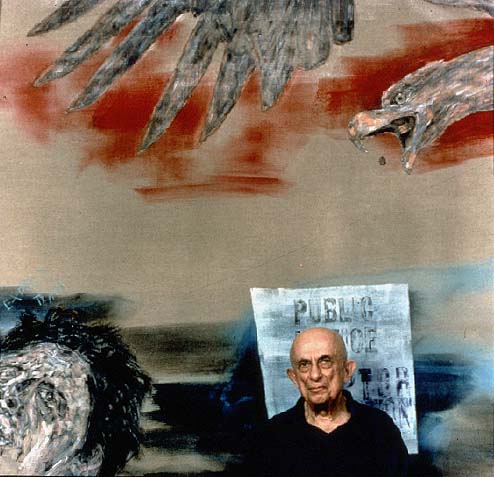
Artist who depicted scenes of war, torture and oppression in large-scale figurative paintings. Golub drew upon material ranging from Greek sculpture to mass media photography and developed a technique of scraping the first layer of paint from a canvas, leaving a blistered surface.

His work is in the collections of the Metropolitan Museum of Art, the Museum of Modern Art and the Tate Gallery in London.

Golub's early work featured figures of kings, shamans or monsters, followed by a period heavily influenced by classical models, including a series entitled "Gigantomachies" portraying wrestlers in combat.

An opponent of the Vietnam war, Golub created "Vietnam II" in 1973, a sprawling 40-feet-wide painting depicting American soldiers shooting down Vietnamese. He later created more than 30 portraits based on photos of powerful public figures including President Nixon and Fidel Castro. Later works, including his "Interrogation" and "Mercenaries" series, show images of torture and violence.

Earned a graduate degree from the Art Institute of Chicago in 1950. He lived in Paris before moving to New York in the 1960s. Taught at the School of Visual Arts in Manhattan and at Rutgers University in New Jersey.

Artist who specialized in bizarre and disturbing images of people.